24/7 VETERINARY CLINIC


Veterinary anesthesiology and pain management
Services
Anesthesiology and pain management
Today’s veterinary medicine is utilizing highly advanced surgical techniques, which has led to increased demands on anesthesiology, intensive perioperative care, and pain management in animals.
Patients are classified into appropriate risk groups based on their health status and the type of procedure they are undergoing. This classification is based on the American Society of Anesthesiologists (ASA) scale. If necessary, patients with life-threatening conditions are first referred to an appropriate specialist for additional tests, such as detailed blood tests, cardiac examination (ECG, cardiac ultrasound), imaging (X-ray, ultrasound).
“There are no safe anesthetics, there is no safe anesthesia regimen, there are only safe anesthesiologists.” Robert Smith
Patients are classified into appropriate risk groups based on their health status and the type of procedure they are undergoing. This classification is based on the American Society of Anesthesiologists (ASA) scale. If necessary, patients with life-threatening conditions are first referred to an appropriate specialist for additional tests, such as detailed blood tests, cardiac examination (ECG, cardiac ultrasound), imaging (X-ray, ultrasound).
“There are no safe anesthetics, there is no safe anesthesia regimen, there are only safe anesthesiologists.” Robert Smith
„Nie ma bezpiecznych środków znieczulających, nie ma bezpiecznego schematu znieczulenia, są tylko bezpieczni anestezjolodzy” – Robert Smith
After performing the tests and determining the risks of anesthesia, anesthesiologist selects the method of anesthesia.
There is no universal anesthesia regimen! Each procedure of sedation, general or regional anesthesia is selected individually for each patient after consulting it all with the owner.
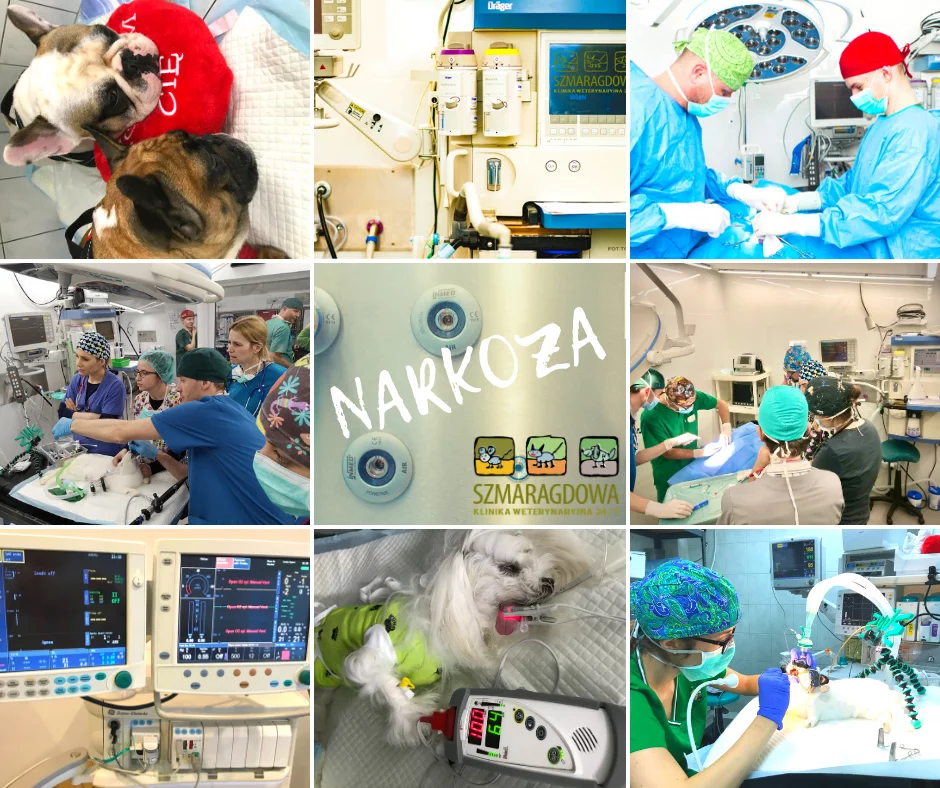
At the clinic, thanks to the newest up-to-date equipment and technologies, knowledge and skills learned at foreign reference centers, we can offer the newest methods currently used in the field of anesthesiology and perioperative care:
There is no universal anesthesia regimen! Each procedure of sedation, general or regional anesthesia is selected individually for each patient after consulting it all with the owner.
At the clinic, thanks to the newest up-to-date equipment and technologies, knowledge and skills learned at foreign reference centers, we can offer the newest methods currently used in the field of anesthesiology and perioperative care:
- sedation
- analgosedation
- neuroleptanalgesia
- general anesthesia using TIVA with special infusion and syringe pumps
- or inhalation anesthesia using first-in-class inhalational anesthetic equipment – for inhalation anesthesia with desflurane, sevoflurane, isoflurane
- local/surface, infiltration, segmental anesthesia
- central anesthesia/block – epidural or subarachnoid
- balanced anesthesia
- monitored anesthesiological care
During each surgical procedure, the patient is closely monitored. The experience and equipment used to control patient safety allows us to perform anesthesia and procedures regardless of the breed, age, and size of the animal. If necessary, the patient is placed on a ventilator. A new feature is the examination of acid-base balance before, during, and after the procedure.
Pain management after the surgery is one of the basic elements of perioperative care. We use preemptive analgesia and multimodal analgesia, which involves pain relief at various levels of pain conduction through the selection of drugs from appropriate pharmacological groups, combined with local anesthesia techniques, thereby increasing the effectiveness of pain relief. In addition to pain management, an important aspect is the prevention of postoperative complications, such as vomiting or circulatory and respiratory depression.
Pain management after the surgery is one of the basic elements of perioperative care. We use preemptive analgesia and multimodal analgesia, which involves pain relief at various levels of pain conduction through the selection of drugs from appropriate pharmacological groups, combined with local anesthesia techniques, thereby increasing the effectiveness of pain relief. In addition to pain management, an important aspect is the prevention of postoperative complications, such as vomiting or circulatory and respiratory depression.
We also treat chronic pain, most commonly in patients with cancer, rheumatic or neurological diseases.
The role of the anesthesiologist is primarily to ensure safety, but the comfort of the animal is also important. During and after the surgery, animals are actively warmed (Bair Hugger system), placed on special mattresses and/or mats with additional heating, and small patients are given special warming pads; we also use solux lamps. In addition, all transfused fluids (“IVs”) are heated to the appropriate temperature using special warmers.
Specialists responsible for animals’ safety during and after the surgeary are our anesthesiologists: Dr. Robert Kraczkowski, Dr. Justyna Szady, Dr. Weronika Lenard-Badurowicz, and Dr. Natalia Szabała.